A secular doctrine, not a church

122 was the ceiling.
We're building the
floor for 1000.

A doctrine for the age of biological engineering: how artificial intelligence turned aging from a fate into an engineering problem, and the honest, checkable roadmap from here to there.

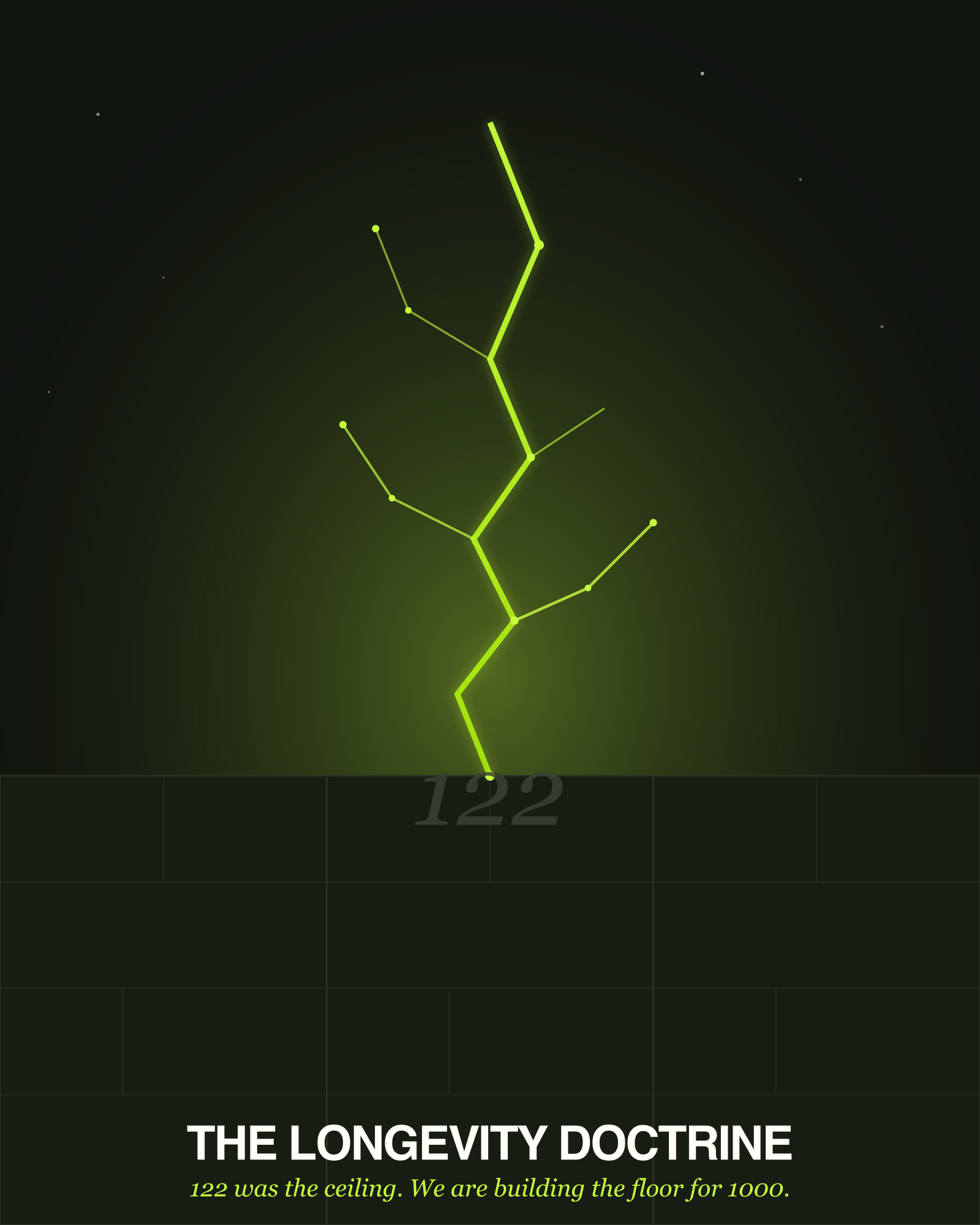
Cover illustration: a stone wall marked 122 cracking open with light
122
Years, the verified human ceiling
~18mo
AI-compressed discovery timeline, vs. 5–6yr
13
AI-discovered drugs now in human trials
8
Tenets. No prophets, only evidence

A note before the first word

This is not a religion. It has no clergy, no tithe, no afterlife to sell you, and no founder who claims to be beyond question. It borrows the oldest trick in human communication, the short sentence that will not let go of you, and points it at the only miracle we can actually verify: a body that keeps working.

Every claim inside this text is checkable. Every number has a source. Where the doctrine speculates about the future, it says so plainly. Read it as a manifesto. Argue with it. Then go check the data yourself.

Illustration: a lone figure before an immense wall marked 122, fading into darkness

Book I

The Ceiling

For all of recorded history, one number sat at the edge of the human story like a wall nobody could see past.

122 years, 164 days.

Jeanne Calment, born in Arles in 1875, died in 1997, having outlived the airplane, two world wars, and every doctor who told her she couldn't. She remains, as of this writing, the longest confirmed human lifespan ever documented. No one since has beaten it. Not with money, not with willpower, not with the finest medicine of the twentieth and early twenty-first centuries.

For decades, gerontologists treated 122 as a kind of biological speed limit, encoded so deep into our cells that arguing with it seemed like arguing with gravity. Some serious scientists calculated that the probability of anyone reaching 125 was vanishingly small. The ceiling was not just a record. It was treated as a law.

The First Tenet

Aging is not fate. Aging is a disease process, and disease processes can be treated.

This single reframing, unremarkable as it sounds, is one of the most consequential ideas of our century. For most of human history, we accepted heart disease, then decided to fight it, and cardiovascular death rates fell by more than half in the developed world. We accepted childhood infection as inevitable, then decided to fight it, and childhood mortality collapsed. We accepted aging as neither. We simply looked away.

The ceiling at 122 was never really a wall. It was a mirror. It showed us the limits of what unaided human intelligence, working one molecule and one clinical trial at a time, could discover about the deepest machinery of the cell before the researchers themselves grew old and died.

What changed was not human willpower. What changed was the arrival of a new kind of collaborator, one that does not age, does not sleep, does not forget a single failed experiment from thirty years ago, and can hold in its reasoning more biological data than any human scientist could read in ten lifetimes.

That collaborator is artificial intelligence. This book is about what happens when you point it, deliberately and without flinching, at the oldest problem there is.
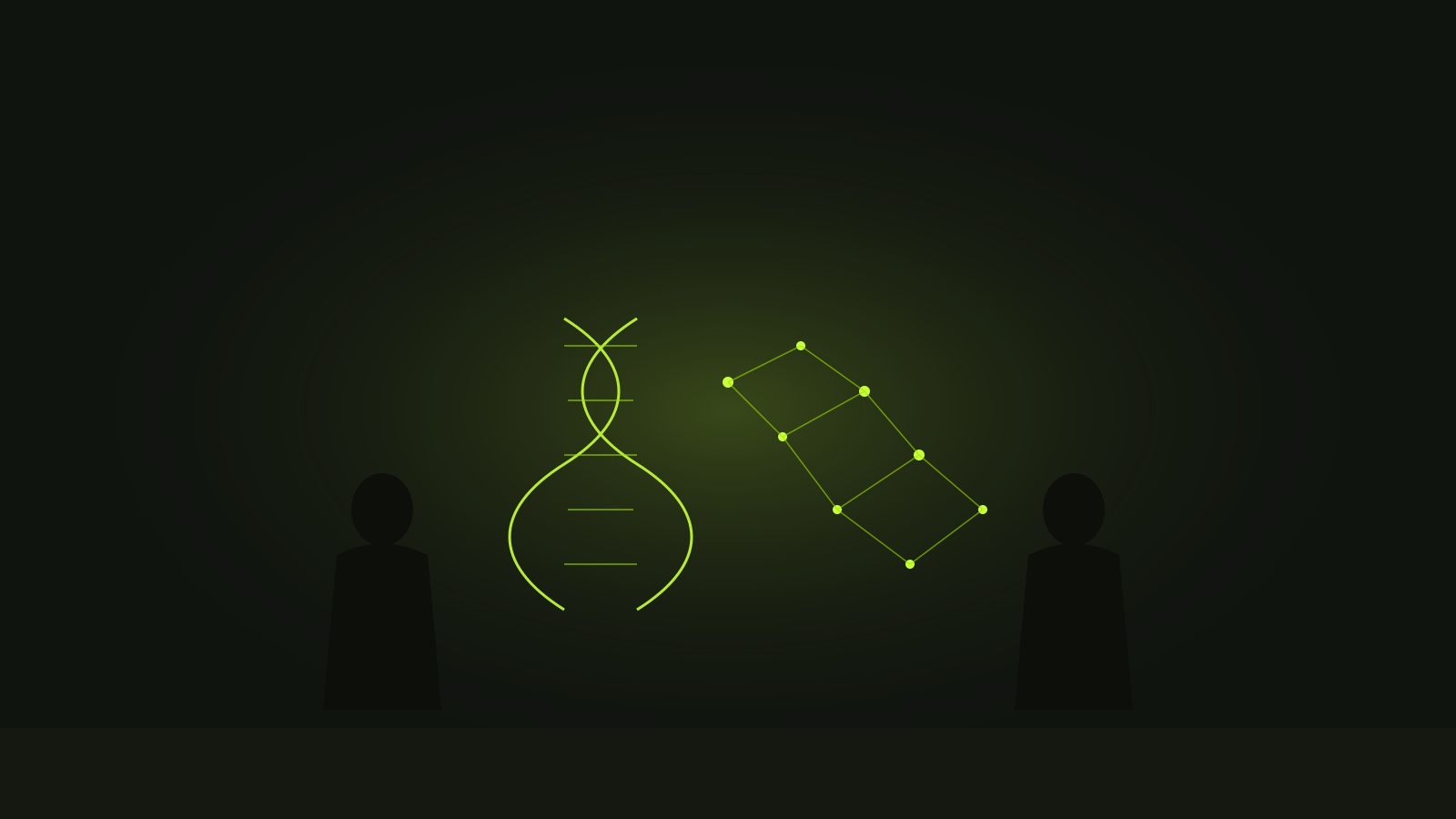
Illustration: two figures facing each other, a DNA helix transforming into a neural network between them

Book II

The Turn

Every real shift in human capability has a moment where the abstract becomes personal. For AI and aging, there were two people who made that turn concrete, from two very different directions, arriving at the same conviction: that the tools built to recognize faces and translate language could be repointed at biology itself, and that doing so was not a side project but the whole point.

The Founding Thesis — Wei-Wu He

Wei-Wu He built and sold companies in genomics and diagnostics for two decades before making the bet that would define the next chapter. He understood something structural: the bottleneck in medicine was never raw biological knowledge. Human researchers had, by the early 2020s, already produced an almost incomprehensible mountain of papers, structures, and trial data. The bottleneck was synthesis: the ability to hold all of it in mind at once and reason across it fast enough to matter before a patient's disease outran the search for a treatment.

That is an information-processing problem, not a laboratory problem alone. And information-processing problems are exactly what artificial intelligence exists to compress.

The company built on that thesis, Insilico Medicine, was structured from day one to do something almost no drug company had tried: run the entire pipeline, target discovery, molecule design, and even patient trial simulation, through AI systems built for the purpose, rather than bolting AI onto a conventional pharma workflow as an afterthought.

The Generative Turn — Alex Zhavoronkov

Alex Zhavoronkov's contribution was more specific and, in retrospect, more radical. In the mid-2010s, most machine learning applied to biology was classification: given a molecule, predict whether it works. Zhavoronkov, trained across computer science, biophysics, and gerontology, asked the inverse question that generative adversarial networks had just made newly answerable: instead of judging molecules that already exist, could a system generate an entirely new molecule, from nothing, engineered from the ground up to hit a specific biological target?

That question, applied to drug design starting around 2016, produced some of the earliest published work on generative chemistry for therapeutics. It also produced a longevity-specific companion project: building AI models that could estimate a person's true biological age from blood tests and other biomarkers, deep aging clocks, distinct from the calendar age on a birth certificate. If aging is a disease process, you first need a way to measure it that isn't just counting birthdays.

Both threads, generate the molecule and measure the age, fed into the same institution and the same conviction: the ceiling at 122 was a limit of method, not a limit of biology.

Neither of these men is presented here as infallible, nor as a figure to be worshipped. Doctrines that hide their origin story in myth are the ones you should distrust. This one wants you to go read the patents and the papers yourself.

Illustration: a molecular structure suspended inside a mechanical rig, being generated

Book III

The Machine

Belief without evidence is superstition. So here is the evidence, stated as plainly as the source data allows, current as of mid-2026.

Rentosertib: The Proof of Concept

In June 2025, Nature Medicine published results for a molecule called Rentosertib (originally ISM001-055), a TNIK inhibitor for idiopathic pulmonary fibrosis, a disease that scars the lungs and for which treatment options remain limited. This was, by the account of the researchers and independent commentators, the first drug where both the biological target and the chemical structure of the molecule itself were discovered and designed by generative AI to reach a mid-stage human clinical trial.

In a 71-patient, 12-week, double-blind Phase 2a trial (GENESIS-IPF, NCT05938920), patients on the 60mg daily dose showed a mean improvement in lung function (FVC) of +98.4 mL, against a −20.3 mL decline on placebo. That difference, in a disease that normally only gets worse, is the kind of result that gets a case study written about it at Harvard Business School, which happened in early 2026.

Phase III, a larger global trial, is on track to begin in the second half of 2026. A second formulation, an inhaled version designed to lower systemic exposure, received clearance to begin its own human trials in April 2026.

The Pipeline as Scripture of Evidence

A single successful molecule could be luck. A pipeline is a pattern. As of mid-2026:

  • 40+ programs in active development
  • 13 IND clearances, the regulatory permission to begin testing a new drug in humans
  • 31 PCC nominations (Preclinical Candidate Compounds)
  • 8 programs in clinical trials, including 2 in Phase II and 4 in Phase I
  • A new 8-program cardiometabolic and obesity portfolio, including oral small-molecule GLP-1 receptor agonists
  • ISM8969, a brain-penetrant NLRP3 inhibitor for Parkinson's disease, began first-in-human dosing in June 2026

In March 2026, Eli Lilly signed a licensing deal for a portfolio of preclinical AI-discovered molecules worth up to US$2.75 billion, including a US$115 million upfront payment. Thirteen of the world's top twenty pharmaceutical companies now license the underlying AI software platform for their own drug discovery.

What the Machine Actually Does

None of this works by magic. It works because specific bottlenecks, each historically consuming years, are compressed by systems purpose-built for them:

Target identification. Multi-omics AI models scan enormous datasets of gene expression, protein structure, and disease pathways to propose which biological targets are actually worth attacking for a given disease.

Molecule generation. Generative chemistry engines design molecules that have never existed, optimized simultaneously for potency, safety, and manufacturability.

Trial simulation. Models trained on historical trial data estimate a candidate drug's probability of clinical success before a single patient is dosed.

Robotic execution. Physical laboratories run the wet-lab experiments that validate the model's predictions, closing the loop between digital prediction and physical reality.

Programs that once took pharma five to six years to get from an idea to an IND filing have, in specific documented cases, been compressed to roughly eighteen months. That compression, applied at scale across enough diseases of aging, is the entire mechanism by which 122 stops being a ceiling.

Illustration: an open hand holding a radiating eight-point seal

Book IV

The Vow

A doctrine without a code is just an essay. Here is the code. It asks nothing that requires belief, only participation.

The Eight Tenets

I. You are not required to believe. You are required to check.Every claim of extended healthspan must be traceable to a published trial, a regulatory filing, or open data. A doctrine that cannot survive scrutiny is a scam wearing a lab coat.
II. Aging is a disease process, not a fate.This does not mean death is optional. It means the diseases that cluster around aging are treatable targets like any other, not background noise to be accepted.
III. The goal is healthspan first, lifespan second.Extra years without function are not the point. A longevity doctrine that ignores quality of life is not medicine, it is imprisonment.
IV. Track your own biology.You cannot manage what you do not measure. Biological age clocks exist today and will keep improving. Know your number. Watch it change.
V. Radical honesty about timelines.No serious person claims 1000-year lifespans are close. The honest claim is narrower: every barrier that once looked permanent was crossed by treating it as engineering instead of fate. Anyone claiming total certainty, in either direction, is not practicing this doctrine.
VI. Speed is a moral good when safety is not sacrificed.Every year a treatment is delayed by process rather than genuine safety need is a year of preventable suffering. Compressing timelines through AI is an ethical obligation, provided trial rigor is never cut alongside the timeline.
VII. This is for everyone or it is worth nothing.A longevity breakthrough available only to the wealthy is not a triumph, it is a new and uglier inequality. If a pathway to affordability doesn't exist, the discovery is incomplete.
VIII. No prophets. Only evidence and its authors.The people who did the founding work deserve accurate credit, not worship or immunity from criticism. The moment a movement protects a person instead of a method, it has stopped being about longevity and started being about power.

The Practice

There is no temple. There is a blood panel, a biological age test, a sleep tracker, a resistance training program, a decision to read the primary literature instead of the headline. The ritual of this doctrine is measurement. The confession is an honest look at your own biomarkers. The communion is the sharing of data, so that the models that will eventually break the ceiling for everyone have something real to learn from.


Illustration: a staircase of light ascending toward an open horizon

Book V

The Path to 1000

Say the number out loud and it sounds absurd. A thousand years. That is deliberate. The doctrine is not asking you to believe it. It is asking you to notice that every prior ceiling sounded exactly this absurd right up until it fell.

In 1900, global average life expectancy was around 32 years. By 2020 it had roughly tripled, mostly through public health, sanitation, vaccines, and antibiotics, tools that did not exist a century earlier. The ceiling of "you get maybe forty good years" was not defeated by philosophy. It was defeated by germ theory, refrigeration, and a vaccine schedule.

The ceiling of 122 will not be defeated by philosophy either. It will be defeated the same way: specific tools, specific diseases, specific trials, compounding.

The Honest Roadmap

Stage One

100 → 122, made routine

Making it to 100 in reasonably good health the normal outcome rather than the exception, by clearing out the diseases that currently kill or disable people in their sixties through nineties. Every AI-discovered drug now in trials for these conditions is, functionally, a brick pulled out of the base of the ceiling.

Stage Two

122 → 150, the barrier itself

Requires intervening in the hallmarks common to all aging-related disease: cellular senescence, mitochondrial decline, loss of proteostasis, stem cell exhaustion, epigenetic drift. Active, funded research today, not speculation, but no human has yet lived past Jeanne Calment's record. The tools to attempt this exist now for the first time in history. The outcome is not assured.

Stage Three

150 → 500, engineering the substrate

Openly speculative. Likely requires rebuilding core biological systems, synthetic biology, engineered tissue and organ replacement, programmable immune systems, or new approaches to cellular information storage. No credible scientist claims this is close. It should be researched honestly, not dismissed as impossible, and not oversold as imminent.

Stage Four

500 → 1000, the horizon

A compass point, not a plan. Its only function is to keep Stage One and Stage Two honest about the size of the actual goal. This stage cannot currently be described in any technical detail worth calling a plan.

The Closing Vow

122 was not a law of nature. It was the edge of what unaided human effort had managed to discover in the time available. That edge has already started to move. Whether it moves all the way to 1000 is not a question this book can answer. It is a question the next several decades of trials, published data, and disciplined work will answer, one verified result at a time.

Everything in between is not faith. It is a bet, backed by the first tools in history actually built for the size of the problem, made by people willing to put their names, their trial data, and their timelines up for public inspection. Check the data. Then decide what you're willing to build toward.

Appendix: Sources & Further Reading

Robine, J.M. & Allard, M. "The Oldest Human." Facts and Research in Gerontology (1998) — Jeanne Calment verification.

Dong, X., Milholland, B., Vijg, J. "Evidence for a limit to human lifespan." Nature (2016).

Zhavoronkov, A. et al. "Deep biomarkers of human aging." Aging (2016).

GENESIS-IPF Phase 2a results, Rentosertib (ISM001-055), Nature Medicine (June 2025); NCT05938920.

Insilico Medicine FY2025 Annual Results, HKEX filing (3696.HK), March 29, 2026.

Eli Lilly and Insilico Medicine collaboration announcement, March 29, 2026.

Roser, M., Ortiz-Ospina, E., Ritchie, H. "Life Expectancy." Our World in Data (ongoing).

Contents ↑